Two months ago I was out having a drink in London. And someone says to me, ‘How can you be out having a drink?’ I say, ‘What the fuck are you on about?’ He says, ‘If I was you I’d be in my room chopping myself up by proxy for Richey.’ People think they know how they’d react if they were his friend. But I don’t feel that I’d been Richey’s friend at that point, because you didn’t have a clue what had happened at all. There were no equation.
THE PURE MOTIVE
It’s an origin story that now seems as notorious and as recognisable as Bruce Wayne’s parents being gunned down in Crime Alley. Yaddayaddayadda, eve of American tour, yaddayaddayadda, Vauxhall Cavalier found parked on Severn Bridge, yaddayaddayadda, not seen since February 1st 1995. And if I were to map out the disappearance of Richey Edwards (the band’s co-lyricist, Minister of Propaganda, and “guitarist”) here again in detail you’d probably let out a groan at the waste of time similar to that you’d release were the next Batman film to feature of yet another scene explaining what happened to Thomas and Martha. Also, I don’t want to victim blame, Mr and Mrs Wayne, but ‘Crime Alley’? What did you think was going to happen?
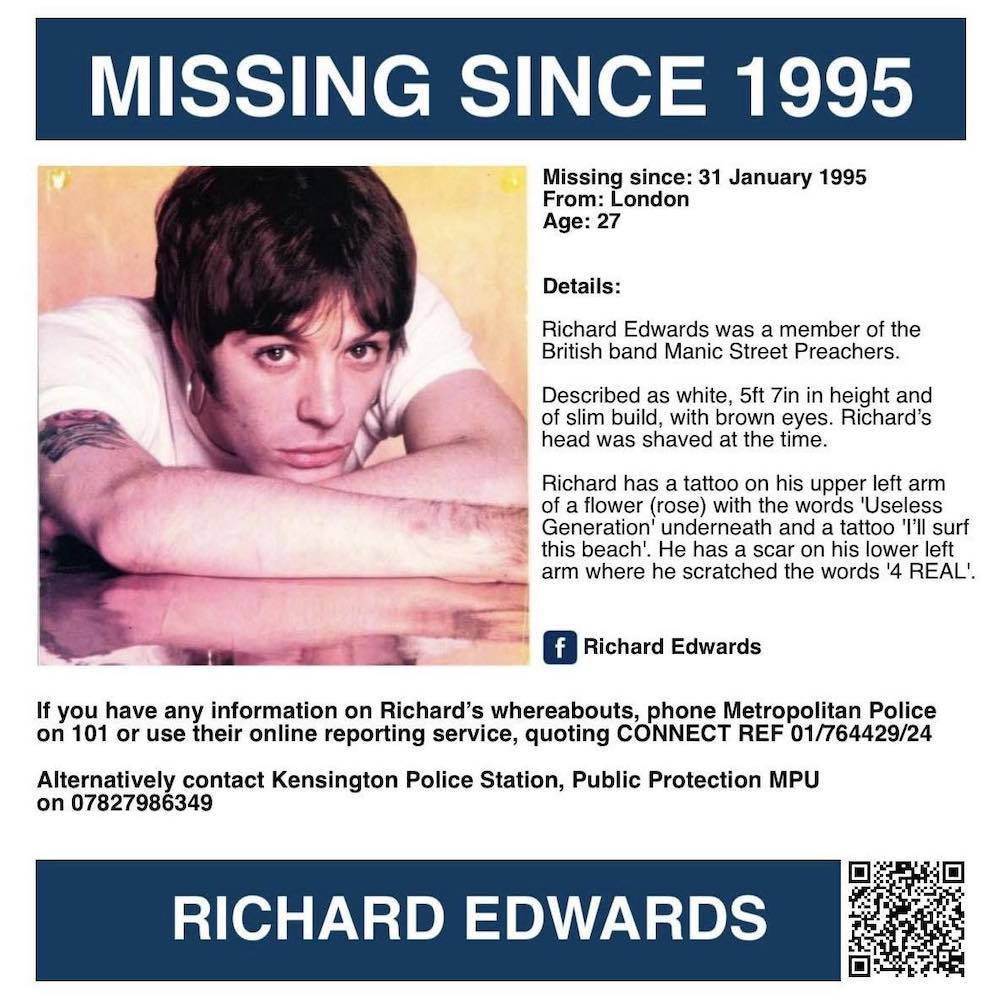
The band would be forced to deal with the emotional devastation of the never solved disappearance of its central member and the members’ childhood friend for the rest of their career. Though, even by the point of that missed flight to the US, Richey Edwards had long been taken from them. ‘The Cult of Richey’ may not have been named as such yet (and, as far as I can tell, may well have first been coined by Manics bassist Nicky Wire to refer to the hysteria around Richey’s disappearance in 1996), but it really began to form following Richey’s hospitalisation just before the release of ‘The Holy Bible‘. And then that album was released – with its largely Richey-penned lyrics that perfectly chronicled the overwhelming power of everything on our fragile and sensitive souls – and it was like, no, he’s ours now, you can’t have him. Even before Richey’s disappearance, fans would write into NME and Melody Maker expressing how deeply they understood his condition. Even suggesting that, maybe, only they know how to save him? And what was all Richey’s self-harm and self-destruction if not our saviour offering up his own sacrifices to atone for our sins??
The problem with being as talented as any artist in history at giving voice to the inner torments of humanity, is that people are going to start believing in real parasocial connections. How could they describe my feelings so well if we weren’t already so close??
But the problem with artists is that they have an infinitely frustrating tendency to move on and evolve far quicker than their audience.
HEROES OR VILLAINS? MAKE YOUR CHOICE
However, Sean Moore, Nicky Wire and James Dean Bradfield weren’t coming to terms with the tragic loss of one the late 20th century’s most incisive lyricists and debating whether his brutal incisions of the spiritually bankrupt human condition had contributed to his inevitable self-destruction. They were coming to terms with a friend closer than any family member, who they’d all been inseparable from since childhood, going missing. And – though it might be more difficult to imagine now, after more than three decades of hope slowly seeping away – Richey was just missing. In early 1995, there really was no reason that Richey, with his recent history of “unusual” behaviour, wouldn’t just turn up and announce how much good the rest had done him (“If he turned up like Robert Johnson when he went off in the wilderness for a year and he became the most amazing guitarist in the world we’d go, ‘Right! The next LP is all yours’. That would be cool” – JDB in 1998).
Quite a lot of the fans think that we’re completely disrespectful to the memory of their ‘best friend’ but, at the end of the day, you know, he was my best friend, not theirs…!’
The decision to record again was itself in hope of tempting their friend back, rather than completely moving on. When the band met with Richey’s parents in April 1995 to discuss the possibility of returning to the studio, the wider feeling was that seeing reports of the band back together would likely convince Richey to return. It was in no way an acceptance of Richey’s departure, more a small contribution to the search. And recently, JDB had played Nicky a song down the phone (“REM, Ennio Morricone, with some Tamla“) combining two lyrics that the current sole lyricist had handed to him, that was so good it would likely even convince D.B Cooper to appear and want to join the band. Those two lyrics were called ‘Pure Motive’ and ‘Design for Life‘. JDB mostly concentrated on the latter. Hey Richey! You know how you told a Japanese interviewer in 1993 that the band was trying to “Write a song like Motorcycle Emptiness but make it 3 minutes long, to make it more simple, more economical with words, more accessible, more easy to understand”?? Well, we’ve fucking done it!!
After months of Nicky writing ‘Holy Bible’ lite lyrics, that would tax JDB to find a way to shape a coherent melody out of it, he decided to write a lyric with credible musical form. OK, thought the band, that one’s really good though. On the 26th August 1995, the band announced that they would continue as a three piece (Nicky: “We’ve sat down and discussed whether to record or not at great length, amongst ourselves and with Richey’s family, and basically decided we would have a go“.). On September 24th 1995, the band recorded a very straight and respectable acoustic cover of Raindrops Keep Falling On My Head for the War Child charity album. Sean played a trumpet solo. It was not enough on its own to make concrete conclusions.
Much of the Cult of Richey were up in arms about all of this, expressing their disgust at such disrespect in music magazine letters pages for weeks afterwards. Once again the three remaining members of the band were greeted with condemnation of how badly they were treating their childhood friend, the childhood friend that they must have pushed away somehow, the childhood friend who they had obviously failed. Every decision, every movement from February 1st 1995 onward would have to be soundtracked by the band continually telling themselves: “He was our best friend, not theirs”. Even so, below the hurtful comments of people claiming close understanding of Richey despite never having met him, there was a real question being asked: Was there even any point to the Manic Street Preachers now?
HOPE LIES IN THE PROLES
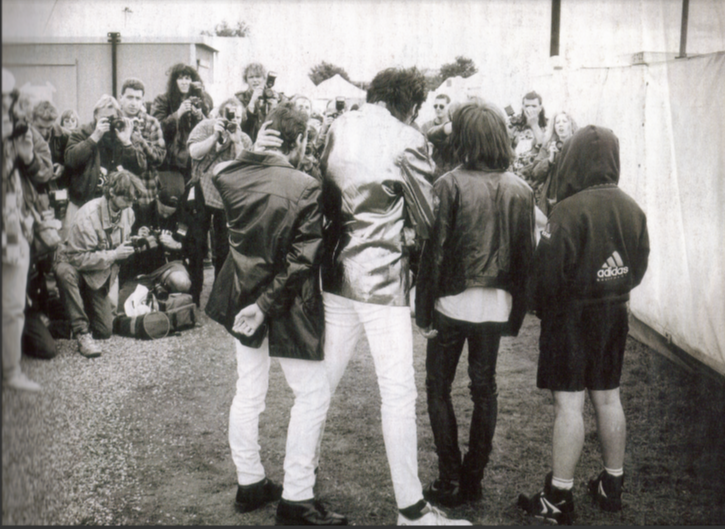
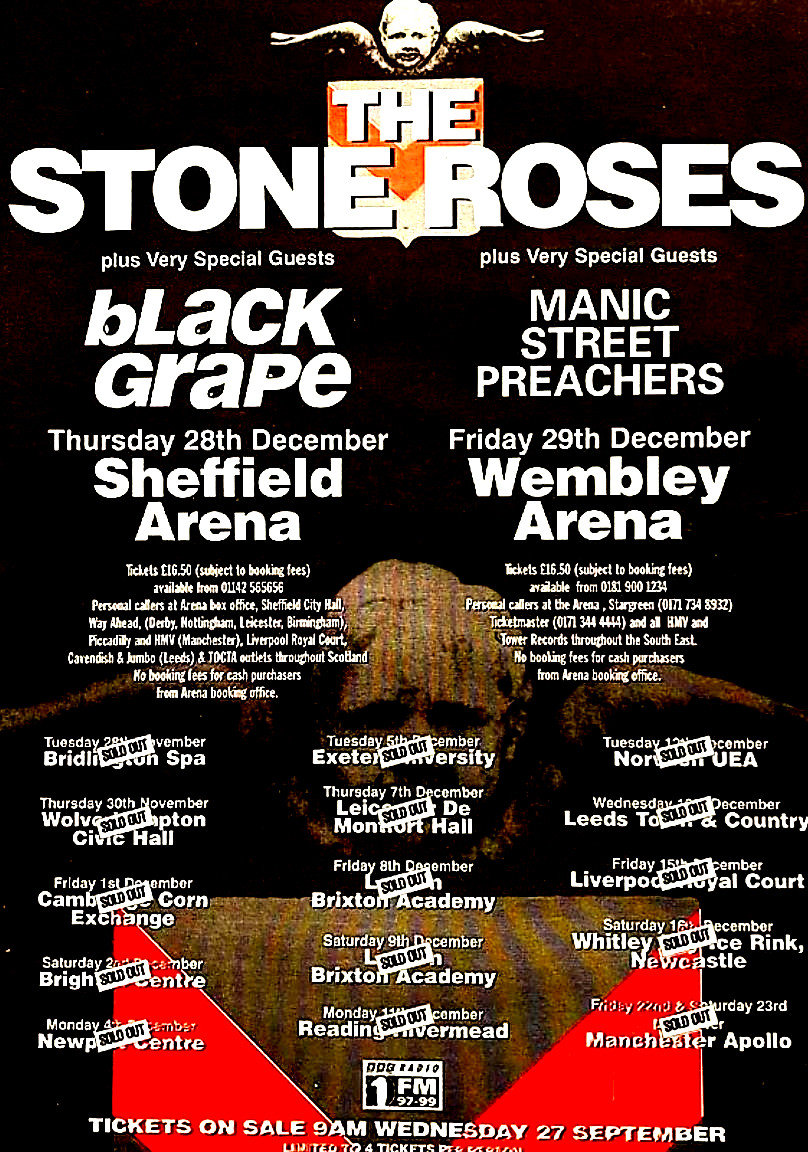
We would finally get closer to answering to that question when the band played their first gig in more than a year, since Richey’s legendary final concert at the London Astoria in December 1994, when they would play a gig at a song out 12’500 capacity Wembley Arena on 29th December 1995, supporting… The Stone Roses? I mean, I can’t remember the band ever saying anything negative about the Manchester band specifically in the Richey era (largely due to the fact that the Manics’ entire recorded career by that point took place years after the Roses debut album and before their recently released follow-up), but weren’t they the kings of the sort of nondescript, apathetic, hedonism positive but politically passive music band that the band made a point of standing out against?? Weren’t the Stone Roses a band for the normies?? Still, many Manics fans still managed to get hold of tickets for a highly desired show just to catch a glimpse of the band that were supporting the actual biggest British rock band return of the year. Showing remarkable bravery/stupidity, these fans came fully glammed up in feather boas, tiaras, white jeans, make-up and leopard print to push through a crowd of 12’000 drunk fans wearing near identical Fred Perry polo shirts and Harrington jackets in order to guarantee they were at the front of the crowd in order to witness this historic return. Finally, in front of a crowd of a few hundred impassioned Manics fans – and 12’000+ disinterested bucket hats discussing their favourite Slowdive album – the lights went down and people witnesses the triumphant return of… the return of… of…
Huh?
Just…
Just a bunch of blokes.
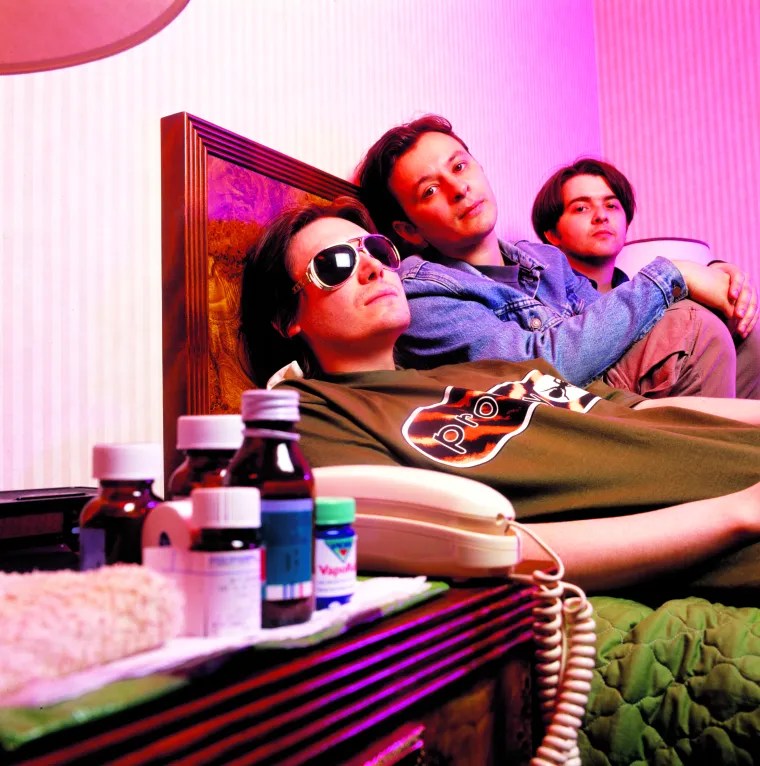
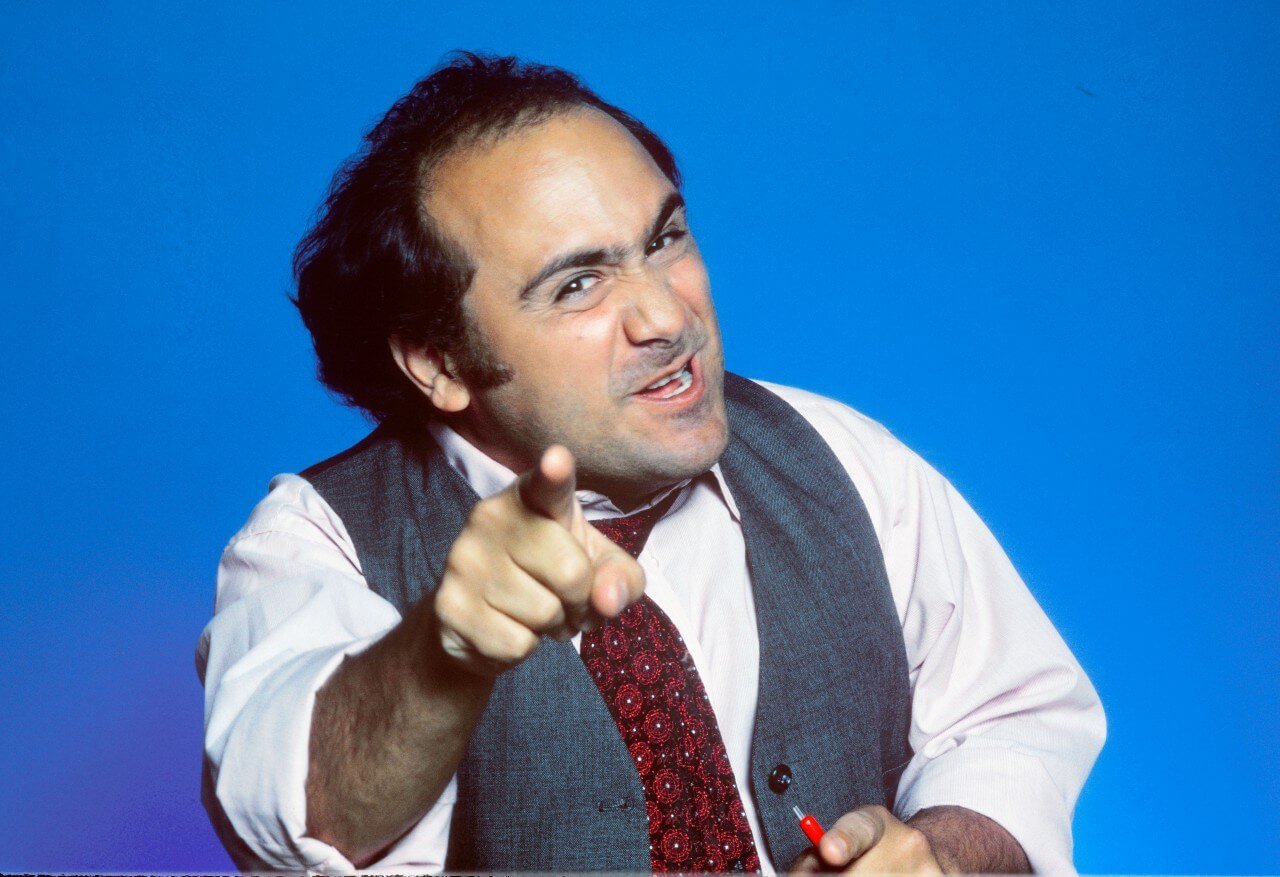
The former messes of eyeliner and spraypaint looked as if they’d only been told about the gig 15 minutes ago and had to cancel a trip to Halfords. JDB wore jeans and a casual white V-top. Nicky wore a baggy Cardiff Devils ice hockey jersey. The crowd were barely acknowledged – and to be fair the feeling was 90% mutual – and the band seemed to be just using the opportunity to have a low stakes rehearsal session. And these motherfuckers were faaaaaaaaaaaaaaaaaat. JDB’s physique was starting to resemble Taxi era Danny DeVito, while Nicky’s Welsh Slenderman frame now came accessorised with a pronounced beer belly, like a bowling ball stuck in a water hose. To the casual onlooker, Richey’s disappearance was solved: those fat fucks obviously ate him. This eagerly awaited and impossibly emotional comeback felt so hollow. What even was the point of this band anymore? They seemed cursed to now walk the Earth as a laudibly adept yet completely commonplace white boy indie rock band. And, trust me, in 1995 we had plenty of those. At one point during the Wembley gig, a “Where the fuck is Richey?” chant broke out in a pocket of Stone Roses fans.
Simon Price captured the confision at the time, as only he can:
The 29th time I see the Manic Street Preachers is in a barn full of cunts.
In the autumn, it was announced that the Manics would support a popular Led Zeppelin tribute act from Manchester at Wembley on December 29th. Previously, James had said “if it ever comes to a point where Richey’s not coming back, we wouldn’t continue”. This fuelled the tempting theory that if the remaining Manics didn’t know Richey was all right, surely they wouldn’t ever consider playing Wembley… so he must be OK… I’m not saying they shouldn’t have done it, and yes, it was fucking brave of them to do it at all. But I am saying – in retrospect – they shouldn’t have done it like this. It was going to feel like a wake whatever happened, so it should have been a cathartic, emotional one. Close friends and family. Two thousands of us, that is, but us not the Adidas-clad baggy throwbacks and Northern Uproar lookalikes gathered to see the headlines. Nonetheless, friends of mine were in tears. I was expecting to be moved, one way or another. I felt numb. They just walked out there, solemnly did the job, and walked off again…
I wasn’t expecting a guitar stood stage right with a wreath around it, or a back-projected B&W photo saying “RICHEY JAMES EDWARDS, 1967-?”, or for Bradders to behave like it was the Freddie Mercury Tribute – “This one’s for you, Richey!” – but their complete refusal to acknowledge the situation was uncomfortable.
As if nothing had happened.
It was fine though, just get that first gig out of your system, we all do weird stuff when we’re grieving, like supporting ideologically opposed Madchester icons. I’m sure it’ll soon be revolution revolution revolution again when you tubby fuckers play your next gigs, which will be… supporting fucking OASIS?? But… but… but… they’re the anti Manics! The Stone Roses may have been the apex of British indie anti-style and intense normality, but at least the band had moments of rebellion and politics, and at least an appreciation of art. Oasis, though, wore their anti-intellectualism on their sleeve, a band who would proudly announce how “people who write and read and review books are fucking putting themselves a tiny little bit above the rest of us” like their illiteracy was a badge of honour. The Gallagher brothers were lauded by the mainstream media in the Uk because, deep down, they believed all Working Class people were like that. If the Gallagher brothers were held up as examples, then all sorts of removal of Working Class rights could be justified. Why give people like Noel Gallagher benefits, they’d only spent it on beers and cigs. Free university for people like Liam Gallagher?? For a degree in what, exactly?? A degree in… degree in… a degree in mucking about?? What a waste of good public funds that could be spent on legal fees for royal sex abusers!! All the work that the band had previously done in attempting to raise the perception of the UK’s Working Class was being eroded a hundred times over by the caricatures of Oasis. Yes, Nicky, you like Oasis’s music – we all liked Oasis’s music – but weren’t the Manics always supposed to stand for more than that?? The Manics fans – not just the Cult of Richey sect* – felt like we were being forgotten. Felt like the band was moving away from us.
And… They kinda were…

(*since you asked, I’m actually of the Seanology denomination)
VIOLENCE FOR EQUALITY
I have lowkey held a grudge against the Manics for a large part of the past 30 years. That sense of rejection – that began when this new, unrecognisable band walked out on the Wembley Arena stage in December 1995 and continued with repeated humiliations until probably the T in the Park 1999 performance – hurt me hard. For a freaking while. You can still taste its not quite dormant prickles in my 2018 review of the band’s rerelease of the ‘This is My Truth Tell Me Yours’ album. Immediately after Richey’s disappearance, the band very consciously matured (spit!), embracing sartorial conservatism, shushing fans and patting their noises down like they were Lorde performing Rider in the Dark. The band seemed to engage in a very deliberate conscious uncoupling with what Richey-era Manics were and the fans that had grown obsessed with them.
I’ve grown to realise that, actually… Yeah, that was exactly what they were doing. And that was so obviously the correct thing to do.
The band were (and likely still are) going through the difficult to imagine trauma of losing someone so close that they may as well have been a part of each band members’ individual sense of self. Someone whose superego was near enough externalised completely in the band’s look, themes and ideology. And when the band are still trying to somehow process this agony, us fans were screaming at them to – essentially – cosplay as the band that Richey externalised. Oh, I’m sorry, do you fat fucks need some sort of trigger warning?? Do the lyrics of ‘Holy Bible’ make you feel like you want a safe space?? Shut the fuck up and play that song about hurting yourself to get pain out and then that one about chronic Anorexia Nervosa!! Oh, and while you do it, we want you to dress like your childhood friend is still here! Us fans are very disappointed, you all seem very cavalier about how much we miss Richey! This is NOT what he would have wanted!!
Seriously, fuck all that noise. Us fans are the worst.
Nicky would explain to the NME that they decided to do a more lowkey comeback supporting other bands because “we wanted to be anonymous; to ease our way into it. The fact that our own fans might be there made me nervous” (with Sean explaining the apparent contradiction of coming back to such massive arenas with “It’s much harder in a small gig anyway, you might recognise a few faces”). But really that kind of explains the band’s whole modus operandi in the period 1995-99: they were all trying to deal with an incomprehensible sense of loss that they could never allow themselves to call grief, they really could nor be dealing with Manics fans right now. Playing to Stone Roses and Oasis fans wasn’t just a way of ensuring as anonymous a comeback as possible – or just a typically Marxist idea of targeting the largest proletarian audience possible – it was a way of playing to exactly the kind of fanbase they wanted at the time. Please, God, give me casual fans! Give me Mondeo drivers that buy two CDs a year! Give me fans in sweaters and blue jeans who have no idea who Richey is! Can, just for a while, I please have less fans showing me their scars and reading me poems they’ve written about the Sonderkommando Lange??
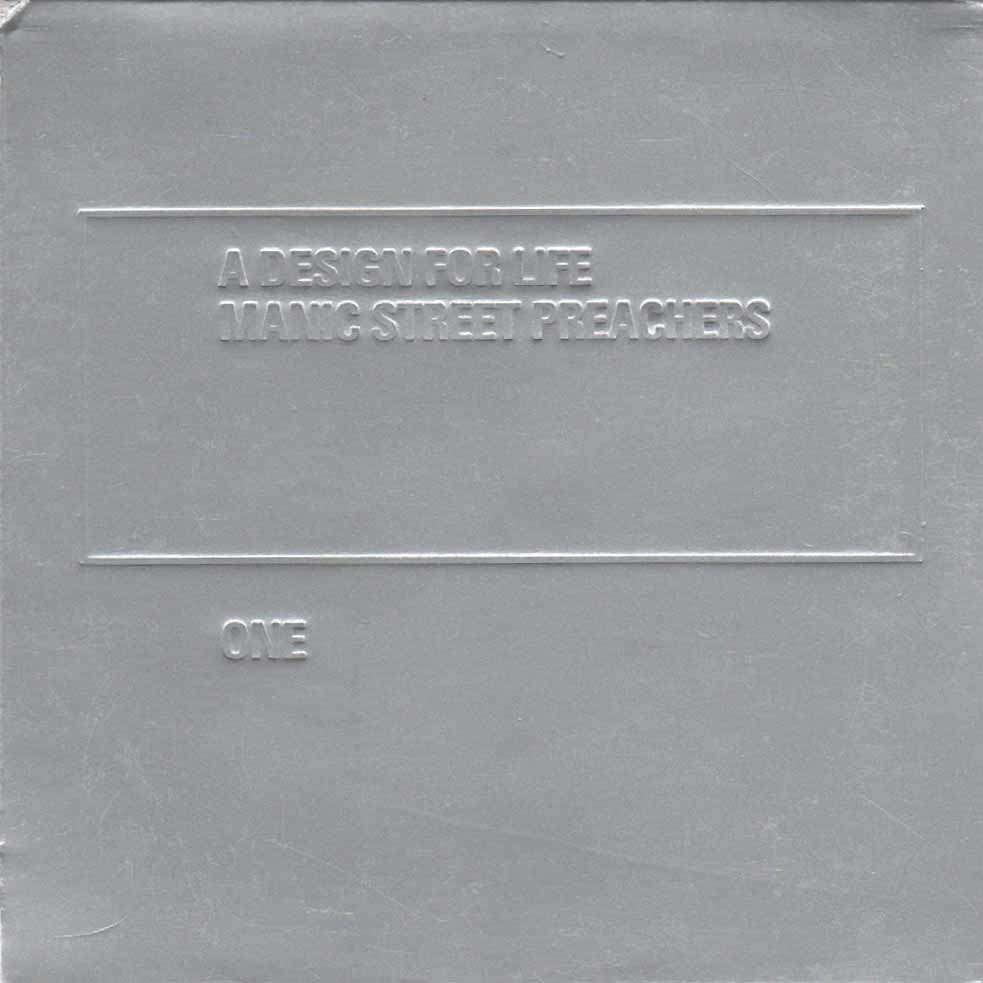
Then, A Design for Life was released on 15th April 1996 and all debates were put on hold.
IS EVERYBODY HAPPY?
I could feel a social history avenue opening up. The anger was starting to come back – the nudge-nudge wink-wink archness of Britpop, turning the working class into something silly, was starting to really annoy me. I can’t deny it, I couldn’t relate to the knowing irony of Pulp, and Blur’s middle-class patronising view of the working class left me cold and angry. I couldn’t stand the silliness. Richey used to say “It’s just bouncy music!”. The endless irony. There’s no fucking irony in working down a pit, no irony in the working-class culture we came from. It’s just hard, it wasn’t about fucking art school. Greyhound racing! I’ve actually been greyhound racing, at fucking Bedwellty, and it’s shit. It was all just too much for me
The importance of Design for Life to the Manic Street Preachers is at once regularly mythologised to a ridiculous degree, yet at the same time impossible to overstate. It’s often portrayed by critics (and often the band themselves) as the one song that convinced them to stay fighting in this crazy business called show. In the inevitable film film biopic* that will eventually be released, there will be a scene where all three of the band members will be in tears, Nicky having just smashed his bass guitar in half and set fire to all the pages of “Useless!” lyrics that he’s written, until JDB absentmindedly starts picking a circular motif on his guitar, inspired by just hearing Frank Sinatra’s Summer Wind, which the movie will have shown playing on the soundtrack of ‘The Pope of Greenwich Village’, which will happen to be on an old TV in the corner of the studio in a previous scene.
NICKY: [shocked, eyes widen] Wait… play that part again…
Or, perhaps it would arise organically through natural conversation;
JDB: It’s no use! I simply can’t go on without the presence of Richey Edwards, our former bandmate who is currently missing! I just don’t have the strength!
NICKY: [sitting next to window, watching the rain come down outside as a tear falls down his cheek] Don’t you think I know?! I remember when I could find all the strength I needed from reading a book by Jack Kerouac or Sylvia Plath, but now I just can’t the power to continue.
JBD: [sighs] Yeah, I remember when libraries gave us power
NICKY: [leaps to feet, grabs JDB by the collar] Wait… What did you just say?!
RICHEY’S GHOST: Sounds like you guys have found a real Design for Life!!
NICKY: We should call it ‘Design for Life’
RICHEY’S GHOST: Hey! That was my idea! Hang on, I’m confused now, can you people see me or not?
SEAN: [Chewbacca roar]
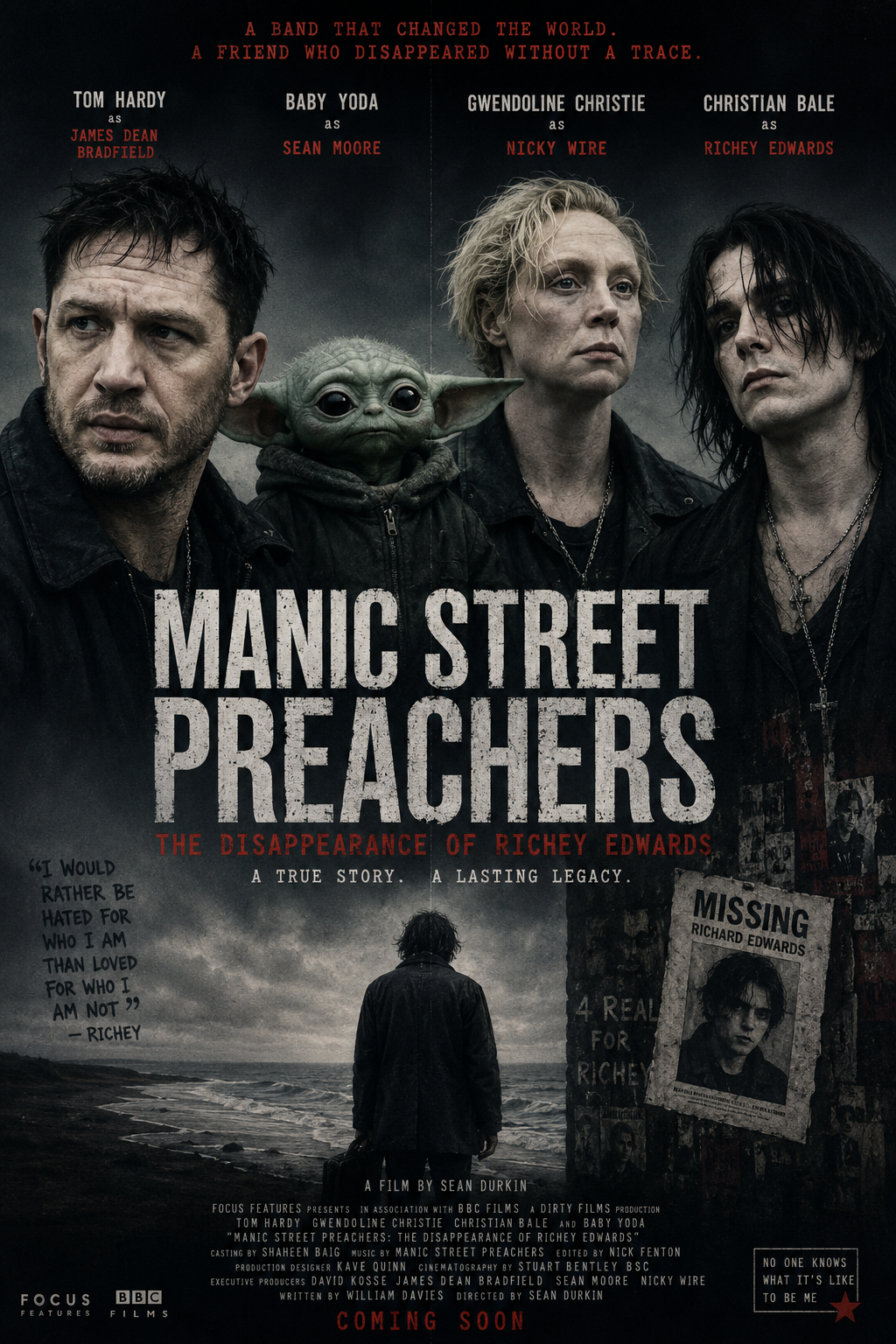
(*Of course, it’s not going to be able to be made as an original film these days, as the industry stopped making those in around 2012, so for the purpose of the theatrical release, producer Mike Hedges will instead be portrayed the Silver Surfer and played by Idris Elba. I’m not being funny, but we really need to attach it to an existing IP)
There was a difficult period before ‘A Design For Life’ of stuff that no-one will ever see. It was a pretty traumatised place and there were a lot of lyrics that were confused and not very good that were trying to be like The Holy Bible’, and then ‘…Design…’ gave me a chance to write in a different voice.
In terms of content, in terms of context, in terms of timing, in terms of emotion, in terms of importance, A Design for Life (#4 best ever) is simply one of the most perfect and joyous songs ever produced. It’s difficult to think of many other songs – many other pieces of art – that managed to similarly not only carry such impossible emotional expectations, but to overdeliver to such an extent that those seemingly overwhelming anticipations would not even be considered a factor. To the relatively small number of Manics fans, it was a comeback song more powerful than they would have dreamed of. More importantly though, to millions more people it was one of the greatest songs they’d ever heard from some band they’d never heard of.
The circular guitar motif is repetitive and yet timeless, seemingly becoming more and more weighted down by pathos and heartbreak with each go around. The infectious guitar is eventually buttressed by a rising and crashing storm of strings. After attempts at recording with Steven Hague at Peter Gabriel’s Real World studio were aborted, Mike Hedges heard a demo of A Design for Life and said it should be a “Jukebox record” – a timeless classic that people would be sticking on the jukebox in pubs for a communal sing-a-long for decades to come like it were a Motown (Junk) classic. The band were convinced, and Design for Life was the first peace of evidence of what a perfect decision having Hdges produce the album was. The strings are exhilarating, JDB’s voice is crisp and better sounding than ever before, Sean hits the drums like he wants to kill them, and Nicky’s bass is… it’s… Listen, it’s fucking fine, alright, but after writing lyrics this good, Nicky had already provided all he needed to.
A gorgeous paean to the Working Class and against the bigotry of low expectations (the kind of lairy, uneducated stereotypes that new besties Oasis were happy to encourage, but let’s move one), that veers between optimistic appreciation and nihilistic hedonism. Much has been made of the wave of Manics’ new fans believing the “We only want to get drunk” line to be celebratory rather than ironic, but they weren’t completely wrong: Nicky was actually speaking semi-literally. The line at once chastises the media’s lazy stereotypes, but also recognises how drink is often the only form of support available to the Working Class (see: JDB’s months long binge across London in the wake of Richey’s disappearance). In many circumstances, if you choose to appropriate the lyrics as being pro-drinking, you more than have the right. Those lyrics that were first passed to JDB sometime in 95 (“As soon as I got those words I thought ‘I’ve got to write the best tune ever’. This was one of the first times in a while when I read a lyric and it sent a tingle up my spine“) are both remarkably un-Manics like (concise?? A legible rhythm? Just thirteen lines??) and yet at the same time the perfect pure distillation of everything the band had ever stood for, right down to the second line – “Then work came and made us free” – referencing the Holocaust.
That first line, “Libraries gave us power”, remans the song’s calling card though, and possibly the central thesis of the entire band. Inspired by an engraving that Nicky saw carved into a pediment on Pillgwenlly Library saying ‘KNOWLEDGE IS POWER’, and eventually sung to the band by a Welsh choir as they opened Cardiff Central Library in 2009.
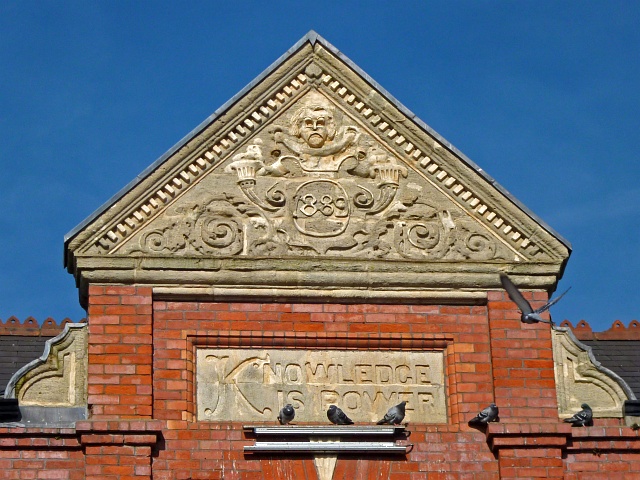
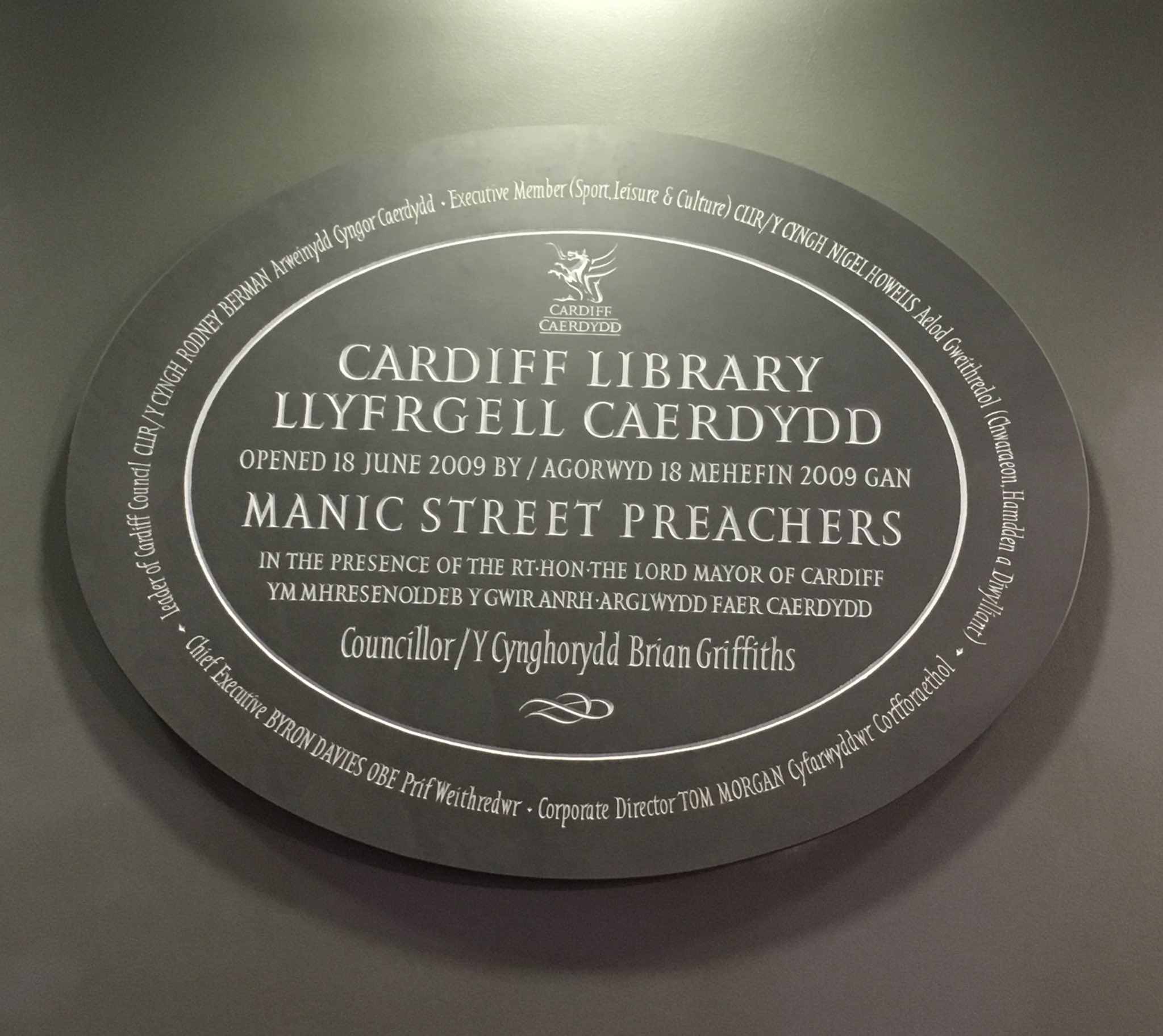
It just fucking sickens me that people have been conned into believing that you can’t think in terms of class any more. As soon as working-class people lose their sense of belonging, they lose all their humility, and you get a classless society in the worst possible sense
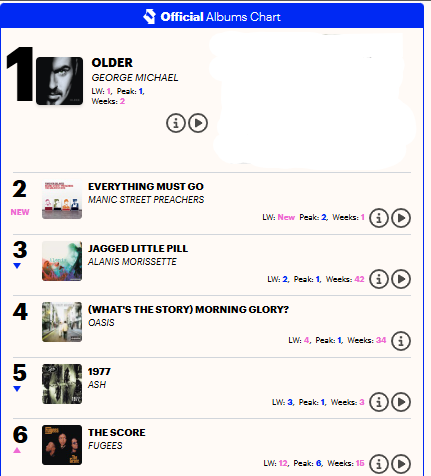
A Design for Life sold 92’000 copies in its first week of release. More than enough to secure the top spots in most weeks, but most weeks aren’t being dominated by the juggernaut known as Return of the Mack. The number two was still the band’s best ever placing by far (their only previous top 10 song had been with their cover of Theme From M*A*S*H), and their first ever proper hit single. JDB knew it was a proper hit because “blokes in my mum’s betting shop were whistling it“. Though Simon Price quotes Nicky Wire being in far more of a bittersweet mood: “I suppose it could be the halcyon days ahead, but getting to No. 2 doesn’t seem like such an achievement. I can’t help thinking: “Richey, if you could have held on a little longer, maybe then you could have had all these things you wanted. You might have been happy”.
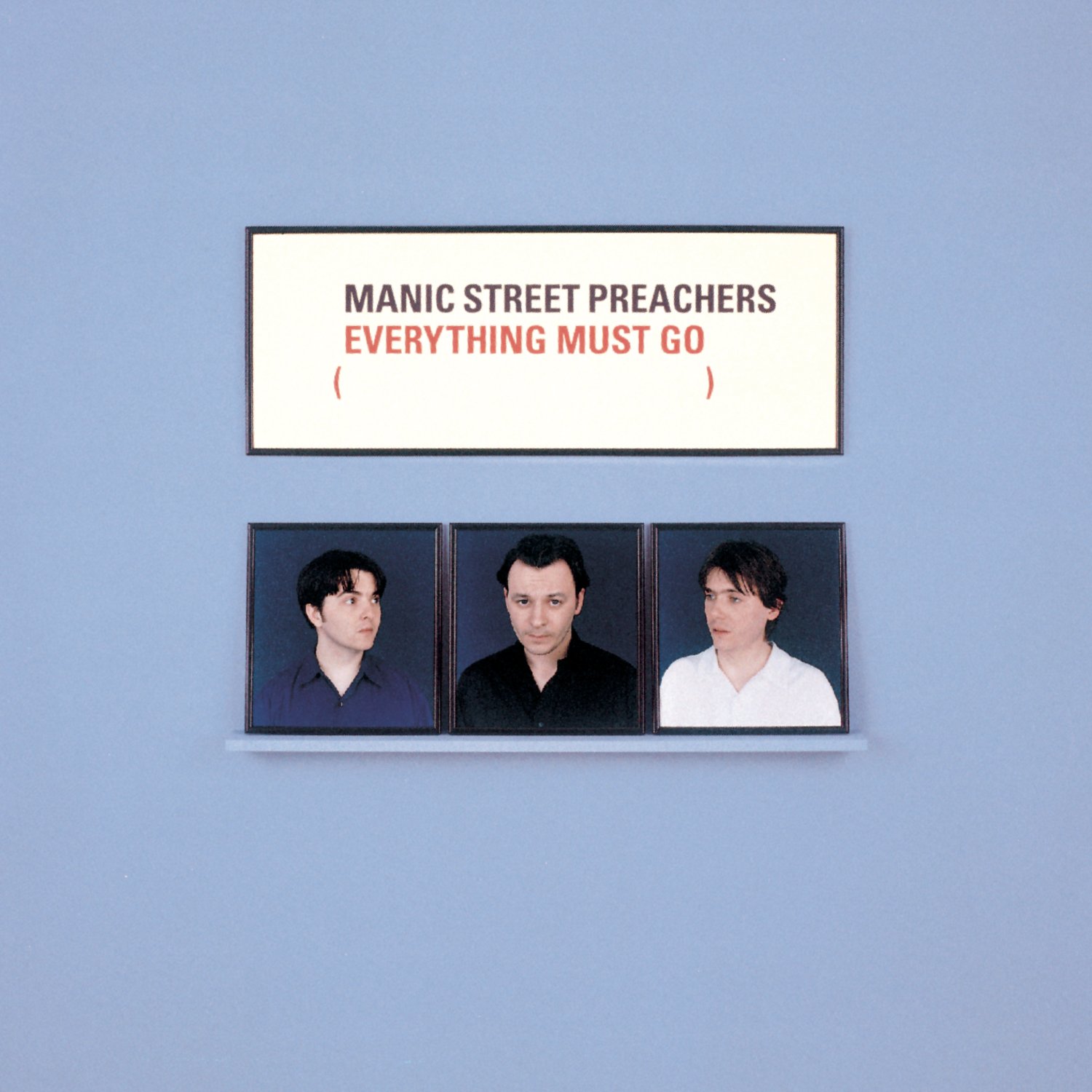
The album the band recorded with Miki Hedges (though containing one song left over from the Hague sessions) had the working title ‘Sounds in the Grass’, named after a collection of Jackson Pollock paintings. However, as you will have noticed, that title absolutely sucks ass. Luckily, Patrick Jones – Nicky’s older brother and current moral superior – was working on a play called ‘Everything Must Go’ at the time, so Nicky just nicked it. Seriously, I would not let my younger brothers Mizdow and Johnny Cash fuck me over like that. Mind you, if I was a poet and my younger brother was a rock star, I guess that brings with it certain automatic privileges. That ‘Everything Must Go’ play didn’t come out until 1999, so Patrick obviously took it hard. According to Steven Hallam above (17, Fetcham, Surrey), the album was fated to be brilliant because the lyrics would all be Richey. In reality, the band did not feel in any way comfortable putting music to Richey’s words that they had no way of knowing he’d approve of (that would have to wait until 2009’s ‘Journal for Plague Lovers’), and so only included songs that Richey had been present for early demos of back in January 1995. By Steven’s calculation, only four of the songs would be guaranteed to be brilliant, while seven would be written by Nicky alone.
It was released on 20th May 1996 and sold 60’000 copies in its first week ‘The Holy Bible’, before it’s 2014 rerelease, would sell about 100’000 records in total. It charted at number 2 again, because The Manics were very much the Arsenal of their day [NOTE TO SELF: JOKE MAY NEED TO BE DELETED].
MAN DOES NOT CREATE. HE DISCOVERS.
And it’s a fucking incredible album. I’ve bored on at length about how ‘The Holy Bible’ is the greatest album of all time – because it is, I just want to make that clear – but I can’t think of many albums ever released that are quite as enjoyable to listen to as ‘Everything Must Go’. Literally every song is a single-worthy karaoke contender, with absolutely colossal melodies and choruses that demand dropping to your knees and adding complementary fist pumping motions to. If you consider all the facets of mainstream rock music – the hooks; the choruses; the solos; the snares; the euphoria; the hands in the air like you just don’t care – then I honestly don’t believe there’s a better, purer, more pristine example of the genre in the whole decade of the 90’s. Which would inevitably include the 00’s, 10’s and 20’s considering rock music died when we were told it was OK to admit to liking Linkin Park.
And the reason it’s so enjoyable is because it’s never quite a completely standard rock album. The lyrics, whether they’re from Richey or Nicky, are obviously generally a few cuts above any other rock music you were likely to hear on the radio in 1996 (“The whole place is pickled/The people are pickles for sure“), ensuring that, even while bellowing your lungs out, each song has as much depth as you were willing to dig at. Sean and JDB’s songs may have been classic after classic after classic, but they also tend to avoid obvious chord changes and never once sway into cheesiness – to make songs this euphoric and this communal without ever prompting rolled eyeballs is some talent. It’s absolutely a Britpop album, but then at the same time not. It’s also sometimes referred to as a huge change of direction for the band, which it really, really isn’t. A huge change of direction from ‘The Holy Bible’, sure, but you’d be hard pressed to find many albums in recorded history that wouldn’t be a radical departure from that. ‘The Holy Bible’ itself was a radical departure from ‘Gold Against the Soul‘ (because you’d be hard pressed to find many albums in recorded history that wouldn’t be a radical departure from), and the glossy, full sounding, maximalist pop rock might have been where the band would have ideally made in 1993 to follow up their glam punk debut, if they weren’t momentarily under the unfortunate impression that they should be Alice in Chains. To accuse the band of ‘selling out’ with ‘Everything Must Go’ is to admit a complete misunderstanding of the early Manics: they’d been trying to sell out since day one, they just couldn’t work out how to. In many ways, ‘Everything Must Go’ was the album that the band – yes, including Richey – had always dreamed of making.
And, 458 days after Richey’s car was found abandoned at a service station near the bridge over the River Severn, the album starts with the sound of lashing waves.
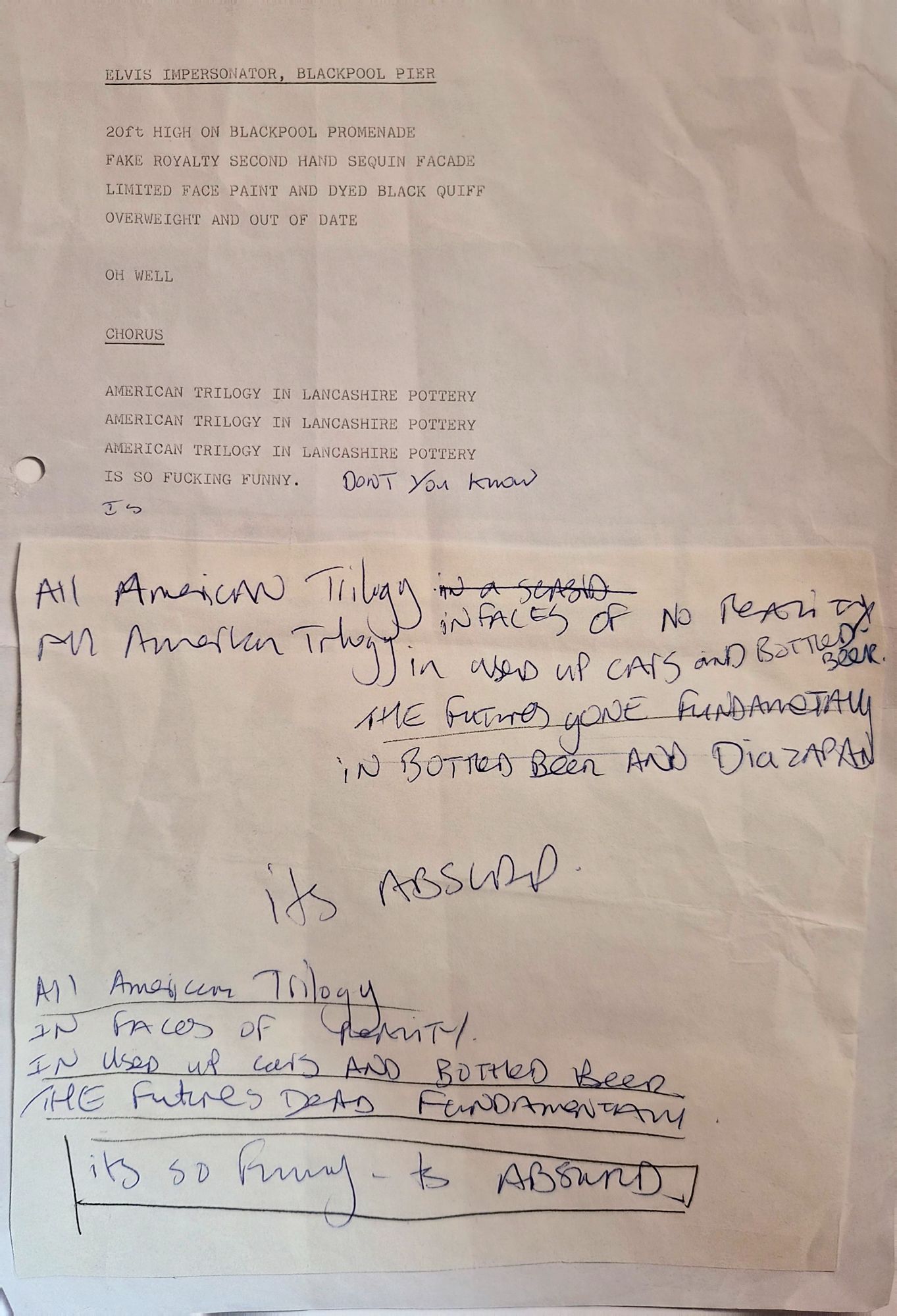
Elvis Impersonator: Blackpool Pier (#30) is the first use of lyrics written by Richey, though later finished by Wire. Though I don’t believe it’s ever been confirmed, the photo of the lyrics that comes with the album’s tenth and twentieth anniversary editions (shown below) do seem to denote what parts were written by each lyricist. Certainly, lines like “In used up cars and bottled beer… The future’s dead, fundamentally” are far more Nicky-coded, whereas killer slogans like “Fake royalty second hand sequin facade” could have been a ‘Generation Terrorists’* era line about the Manics’ attempts to limp on after losing their central figure. The Manics are now themselves the Elvis Impersonators, laughably throwing shapes like they were American Rock Gods despite being overweight and out of date, attempting to persuade people that the very British campy tackiness of Blackpool Promenade is just as prestigious as Las Vegas. An incredible album opener.
(*now the only Manics album that I’ve not reviewed!)
It’s followed by Design for Life, one of the greatest rock songs ever written, and then just casually followed by Kevin Carter (#33. Too low, that needs sorting), another of the band’s greatest ever songs, another modern classic, and another Richey lyric. It’s also a lyric that can so easily be read as linking to the band’s current situation, though far more morbidly. Kevin Carter was a photojournalist who first rose to prominence documenting apartheid in his home country of South Africa, and eventually won a Pulitzer Prize for his harrowing photos of the 1993 famine in Sudan, specifically a haunting photo of a vulture stalking a dying young child. Four months after he received his greatest success after documenting the most horrendous examples of human suffering (“Tribal scars in Technicolor”), Kevin Carter committed suicide, saying in his suicide note that “The pain of life overrides the joy to the point that joy does not exist”. I’m not going to patronise you by pointing out the allegory. Click, click, click, click, click, click himself under. Carter’s guilt over accusations of not helping the child he photographed also carried uncomfortable echoes of the post-Richey accusations aimed at the band: Why didn’t you help them? You were happy to just profit of their pain and offer no assistance?
Aside from the extremely powerful lyrics, with brilliantly abstract sections like “The elephant is so ugly/He sleeps his head/Machetes his bed” that I still don’t think I’ve ever 100% got my head around, Kevin Carter is an incredible piece of music. Rapid stabs of guitars and drums could represent the shuttering of a camera lense or bursts of gunfire (“Bang-Bang Club, AK-47 hour”), and the anxious, malevolent masterpiece is perhaps the closest idea of what ‘The Holy Bible’ might sound like if it wasn’t produced and mixed in order to sound like demonic goats are spitting acid into your ears. And what you get is another UK top 10 single from the album.
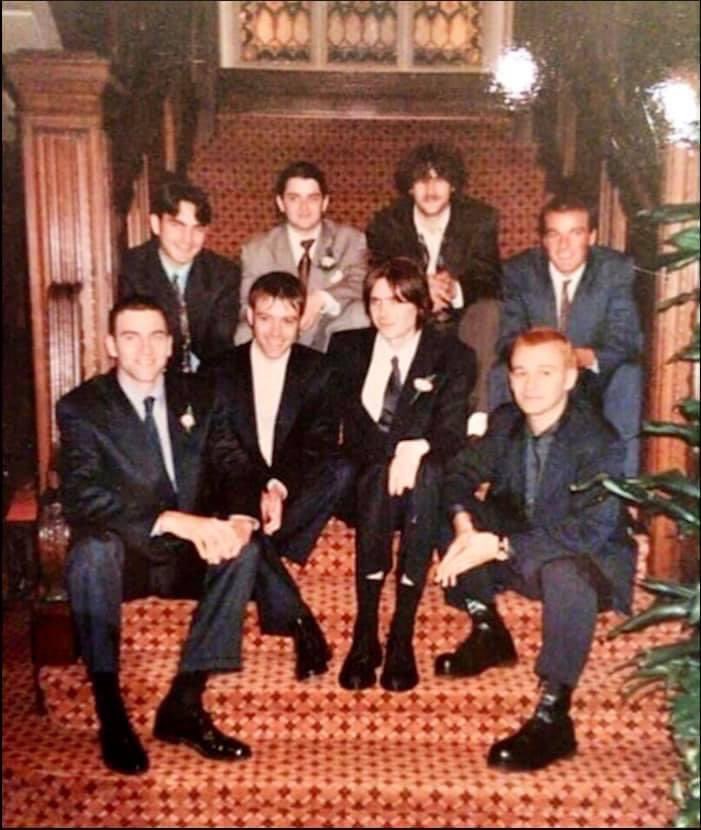
Enola/Alone is the next song, one of the more basic tracks on the album, and easily the weakest song on the album’s first side- though that bar is incredibly high. It’s still a killer rocker, even if the stench of Britpop is probably more pungent here than anywhere else on the album. The (Nicky) lyrics, though, push the song close to heartbreaking. Inspired by looking at a picture of his 1993 wedding and seeing himself next to Richey Edwards and former manager Philip Hall, who were both no longer there with him. It also contains perhaps the album’s most poignant and central line: “All I want to do is live/No matter how miserable it is”. But, whatever, Everything Must Go is the next song so nothing else matters.
I could see there was a hole in the album. The idea of saying ‘The New Manics’ – that we can’t be the band that we were, that we’re going to have to junk the last few years just to be at ease with ourselves. In a nice, concise, almost apologetic way: “I hope you can forgive us, but everything must go.”
Just after Enola/Alone focuses on clinging into memories and embracing your personal history, Everything Must Go (#12) storms the barricades with an army of one hundred elephants and makes the whole album’s central message as clear as possible: Burn the past. This is year zero. Sorry, but it’s all gotta go. Cult of Richey? Tissues for your issues, mate. Freed from their memories. Escaped from their history (HES! TORIEEEEEE!!!). Everything must go. Sequenced after Enola/Alone‘s sad reflections, EMG loudly explains that things need to move on. They hope that we can forgive them (some of us never did). The music itself is big enough to have soundtracked Napoleon decimating the Russian-Austrian army in 1805. It would have been chanted by the 2.5 million Soviet soldiers making the final assault on the Seelow Heights in 1945 (Bradfield actually asked the string arranger Martin Greene to make it sound “More Stalingrad”). It’s the sound in my head when I autoasphyxiate myself to an apocalyptic conclusion. It’s the sublime yet menacing orchestra-implemented sound you get when you face God. Unlike anything the band have done before or since, and a fabulous piece of music that I still think is ever so slightly underrated by the fanbase, perhaps because the band have never quite managed to adequately translate its breathtaking Sturm und Drang to the live setting. And Sean’s fucking drums on fucking this fucking song?? Fuck me dead and bury me pregnant. Reached number five on the UK singles chart, right between Born Slippy and Macarena. What a time to be alive.
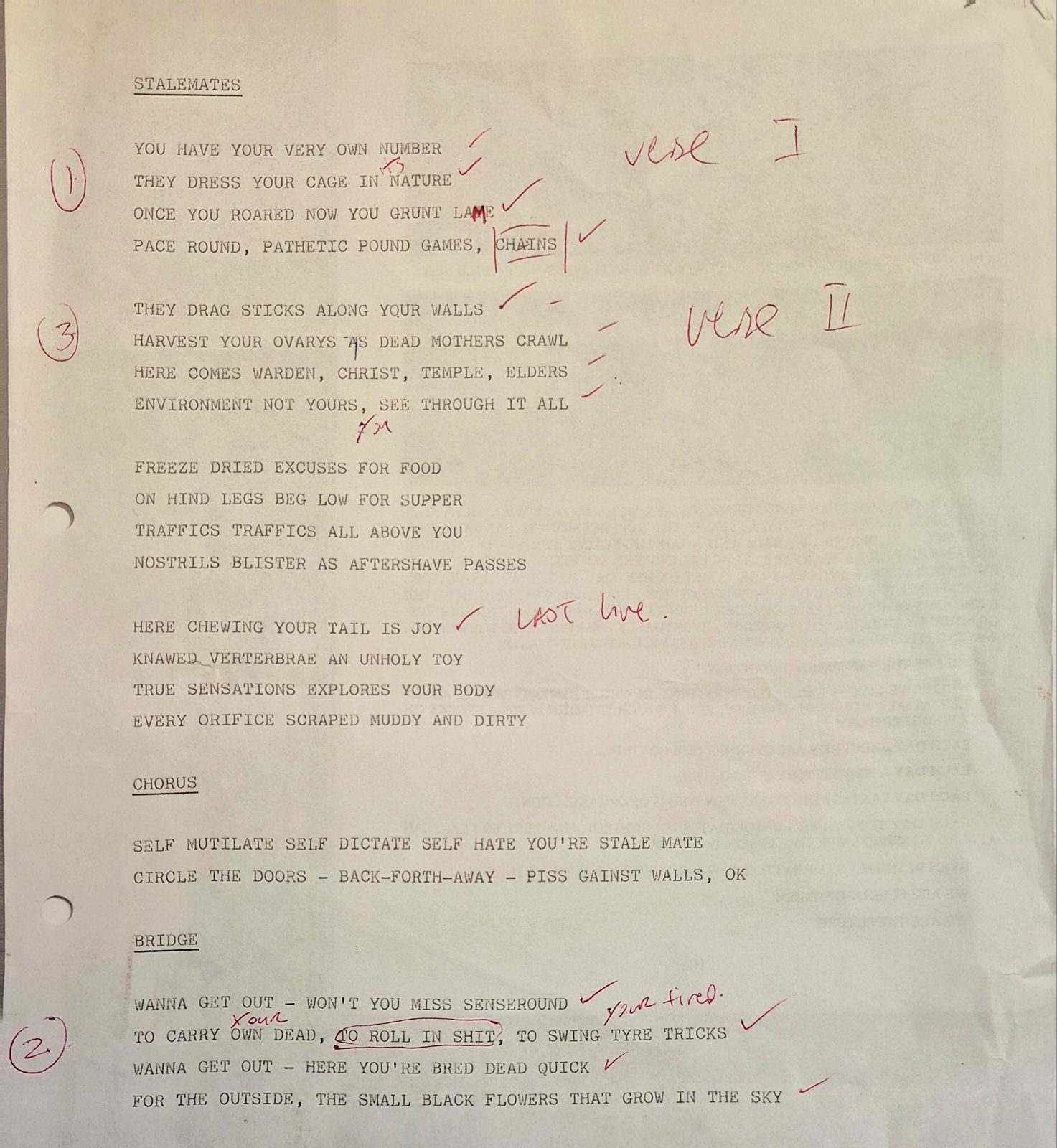
After the emotional ketamine rush of EMG, with lyrics by Nicky*, comes the third Richey lyric, and to this day perhaps the most beautiful song the band has ever done. Small Black Flowers That Grow in the Sky (#14) was apparently inspired by Richey seeing a documentary about abused zoo animals (a documentary I’ve never quite been able to track down), and so obviously phrases like “They drag sticks along your walls/Harvest your ovaries dead mothers crawl/Here comes warden, Christ, temple, elder” immediately started bouncing around in his mind. Musically, it’s little more than acoustic guitar, harp, and enormous pathos. Lyrically, the analogies for Richey’s own mental and physical state are clear (“Once you roared now you just grunt lame/Pace around, pathetic pound games**”), and it perhaps provides proof how hard a task Nicky has always had: he’s spent more than 30 years now writing songs about Richey, but that motherfucker was writing eulogies as good as this before he’s even disappeared. And again, the lyrics contain depths and puzzles that Nicky’s lyrics have never possessed. Like, what exactly are ‘small black flowers that grow in the sky’, anyway?? I have always read it as the tiny crosses made by a meshed cage roof glanced from the animals below, but researching this post I learned that was far from a unanimous understanding. On his blog solely dedicated to breaking down the album’s tracks one by one, ‘Jason’ also mentions how ‘The Black Flower of Brzezinka‘ was the nickname of the spotlight at Birkenau, the largest of the Auschwitz concentration camps, which would at least fulfill Richey’s mission of mentioning the Holocaust in every song he wrote. In an extremely impressive find, ‘Jason’ also discovered that the title is an almost exact line of dialogue in the 1946 film ‘The Best Years Of Our Lives‘, spoken by a WW2 veteran describing a photo of bombs being dropped from planes. The lyrics are at once easy to understand, whether you take them literally or as an analogy, and yet still bear debate three decades later. And this is all despite them taking out the line about pissing against walls!
(*and as great as the song is, lines like “I look to the future it makes me cry/But it seems too real to tell you why” are early warnings of the kind of stagnant and artless rhyming dictionary empty platitudes that Nicky is still wont to carelessly stumble into to this day
**thirty years on, I still choose to believe that it’s meant to be ‘pathetic pound gains‘, even with written evidence to the contrary. It’s just a better line, no??)
Tracks 1-6 of ‘Everything Must Go’ is about as perfect a side as any mainstream rock album has ever had. Side 2 is… Very, very good.
It starts with The Girl Who Wanted To Be God (#85. Yeah, it doesn’t belong on that list, blame the Cult of Richey), which is just an extremely good upbeat rocker featuring some of the more unspectacular lyrics Richey ever wrote (supplemented with lyrics by Nicky, who likely could – cough – match the vibe quite easily). This is, if anything, overcompensated with the next song, though: Removables (#65), and a “Killed God blood soiled unclean again/Killed God blood soiled skin dead again” refrain that could only be more Richeycoded if your learned that ‘Killedgod’ and ‘Bloodsoiled’ were the names of Nazi death camps. I still read people arguing that Removables is one of the weakest tracks on the album – if not the outright worst – and it just brings me great sadness that so many people can so proudly be so ridiculously incorrect. Whatever happened to shame? Keep these rancid takes to yourself. Removables may be heavily indebted to Nirvana, but it’s a thrillingly cold and sinister doomrocker that provides great variety on the record and, like Kevin Carter, offers a glimpse at what a ‘Holy Bible’ era Manics with ‘EMG’s production might have sounded like. And even the lyrics – as Richeymaxxing (“Conscience binds you in chains/Trail by stone hammer and nails/No-one made the holes but me/Misery mourns to be devoured” as they are’- betray a conciseness and rhythmic legibility that was rarely present on ‘THB’, showing how even the songs first rehearsed with Richey present show plans for a far more commercially viable THB’ follow-up. If Richey was writing for an album with simililar overstimulated logorrhea as ‘THB’, he wouldn’t have written lines as succinct and balanced as “Hi, Time Magazine/Hi, Pulitzer Prize”, “American trilogy in Lancashire pottery/Is so fucking funny, don’t you know” or anything on The Girl Who Wanted to Be God (some of that shit rhymes!!). Plus, as Simon Price points out: “Was the chorus – “all removables, all transitory – simply Richeyspeak for ‘everything must go’?”.
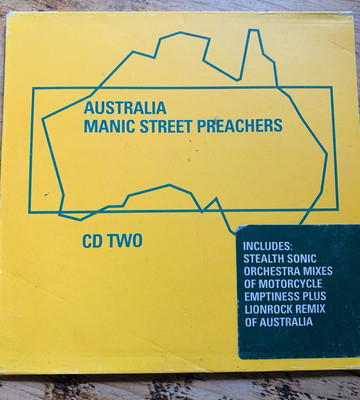
Track nine is the album’s fourth single Australia and the band’s fourth UK top ten of 1996, a feat no other artist could beat (although it was matched by their contemporaries Boyzone, Celine Dion, Eternal, Michael Jacknonce, and their eternal nemesis Mark Morrison*). Australia is a bit of a big balls, rock mini-epic with lyrics that are little more than perfunctory (wanna get away, yeah? Like, to Australia? Because that’s fucking ages away) that I loved at the time (I have such bizarre pangs of nostalgia for the yellow and green coloured cardboard singles sleeves), pretty much rolled my eyes and tutted at for around 25 years later, and only really recently coming back round to its rambunctious glory again. In my defence, your honour, it’s difficult to explain quite how overplayed this brilliant but effectually artistically shallow rock riot was in the late 90s. The song was everywhere that didn’t need the band’s explicit consent, from soft BBC news reports about new koala bears born at Chester Zoo; to trailers for the exciting return of Ainsley Harriot’s Can’t Cook Won’t Cook’; to being seeming broadcast 24 hours a day on every regional radio show for at least four years straight (“I always got a thrill when Australia was used on the Nationwide League’s goal round-ups for three or four years” – JDB in 2016), it was very much the 1996-99 version of Battle Without Honor Or Humanity or XX’s Intro. However, returning to it again after so long just avoiding a song that I’d long considered never needing to hear again, it’s actually a thrilling racket that constantly and skillfully just avoids complete collapse, utilising real musicianship that I’d never previously appreciated. “It’s probably the one song I don’t think we’ve ever done properly live”, Nicky explains in ‘168 Songs of Hatred and Failure‘, “If it goes too fast it falls apart, but it has to be on the edge to fly. It’s such a hard one”.
(*yeah, I know, that Mark Morrison. Trust me, I’ve done my research here, and it turns out one of the most famous one hit wonders of the 90’s actually had three more top tens in 1996 in the UK, plus another one in 1997. Mr Morrison had more top ten singles in 12 months than Pulp have had in their 48 year career)
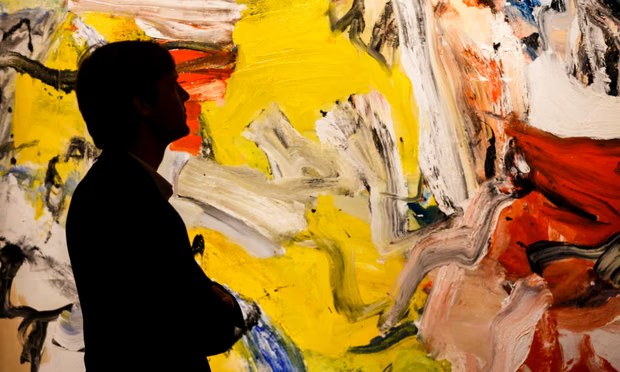
Interiors (Song for Willem de Kooning) (#76) is already a highlight of the album musically. Sequenced brilliantly as a more musically spirited and slightly less dark (or, rather, more mournful than malevolent) sister song to Removables, with one of the album’s strongest melodies and punctuating stabs of instrumentation marking it out as one of the record’s more sonically progressive tracks. Even more intriguing are the Nicky penned lyrics though. Ostensibly about the celebrated Dutch abstract expressionist who continued to produce acclaimed work even as his increasing Alzheimer’s rendered him unable to remember what he was painting and why (he would pass away aged 92 less than a year after ‘EMG’ was released). In the context of ‘EMG’ though, where every Nicky penned lyric contains references to things forgotten and lost, hanging on to memories one moment and wanting them pushed away the next, Interiors reads like a perverse desire for the withdrawal permitted to De Kooning by his condition. It allowed for the same escape from his history that the Manics desired so much at that point, when they were all “too tired to try and understand” and worried that “another era is not forthcoming”. Willem de Kooning’s fate was what the band truly desired in 1996, to be truly lifted out of their memories and be able to create art completely for art’s own sake. It also further cements my long proven theory that every Manic Street Preachers song is actually just being in the Manic Street Preachers. Even the next track, Further Away, which is on one level the record’s low point and the most trite, rote and unimaginative hack meat and stale potatoes nonentity the band had released by that point – a love song?? – is actually about how the band being apart just makes them want to get back together. At least that’s what I tell myself to convince myself its not one of the most pathologically dull lyrics ever written. “The happier I am when I’m with you/The harder it gets when I am alone” Was ChatGPT widely available in 1996? Some of these lines have got to be AI.
The record ends incredibly with No Surface All Feeling (#19). Admittedly, it has gone down slightly in my affections since hearing an early demo of the song which begins with JDB shouting “Hello, my name is Billy Corgan!”. Once you hear that, it really does highlight quite how big a homage to/rip off of ‘Siamese Dream” era Smashing Pumpkins the song is. However, there are worse bands to copy (at the time!), and the high pitched fuzzed out guitar closes the record in doleful yet still oddly anthemic way. The epic doesn’t just sound like the curtains coming down on the band’s fourth album, but a complete closing eulogy to the Manic Street Preachers’ career. Or at least, an end to the Manics you once knew. “For me for you we knew they were lies… It may have worked but at what price… Beg me to stop hate my face I know… Just one thing before I get to sleep/Nothing here but the stains on my teeth/No not blood just liquid from you/I only wish it was the truth”. Richey-era Manics, with their political posturing and agitprop sloganeering, with their DIY destruction on Chanel chic, were often accused of being all style over substance. Actually, no, Nicky states. It was no surface but all feeling. Maybe at the time it felt like dreaming. But it’s over now. It sounds like nothing else but an explicit demand of their fans to move on and mature
What’s the point in always looking back
When all you see is more and more junk
WHEN FREEDOM EXISTS THERE WILL BE NO STATE
And that’s what ‘Everything Must Go’ is. The band can object all they want in retrospect – and they would have never dared admit at the time – but the album is an explicit message to all their old fans that they were moving on. They were being forced to deal with the confusing emotional demands of at once hoping for success that would bring their best friend back; not knowing whether they should be in mourning; and not for one second allowing themselves to mourn someone who could return at any second. The last thing they wanted to do was play dress up to pander to a fanbase that were largely shaped by the visions of that missing friend. ‘Everything Must Go’ (and, to an even greater extent, 1998’s ‘This Is My Truth Tell Me Yours‘) saw them accused of abandoning their hardcore fans, of moving on from the following that obsessed over the Church of Manic. And that’s exactly what they were doing. When the band were trying their best to work out how to still create art departmentalised from the group’s tragedy, the last thing they needed was a cult that centred around triggering that trauma.
They stepped away from their history and had by some distance their most successful period. Then, beginning with 2001’s ‘Know Your Enemy‘ (see below), the band began to make peace with that era of their career and reach out to their old fans again. They would never again be anywhere near as successful as they were in those post Richey salad days.
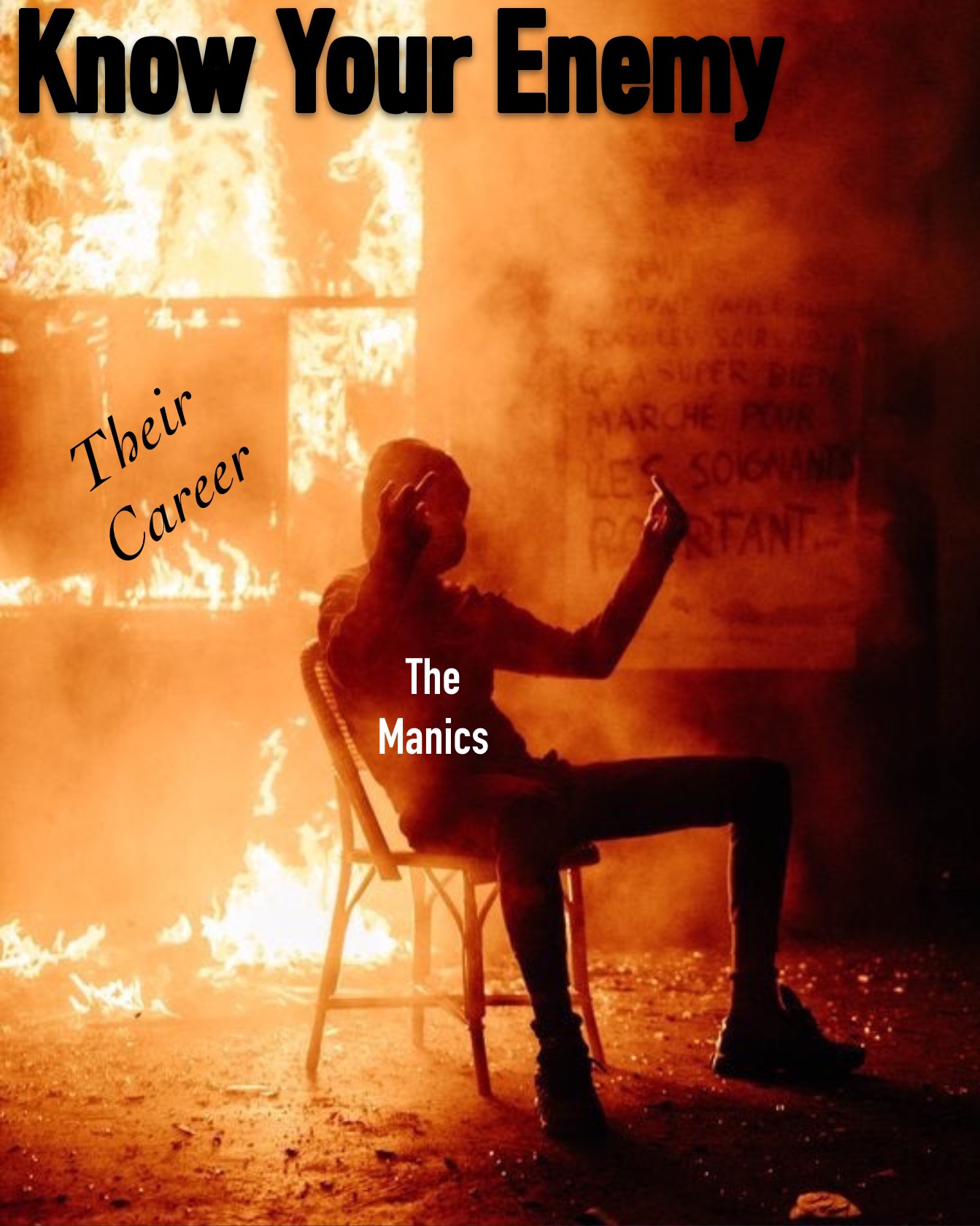
“I just hope that you can forgive us”.
You know what, after 30 years? Yeah, I do.
Shit, does this mean I need another ‘This Is My Truth…” retrospective??
UGLINESS CORRUPTS THE HEART AND MIND
At the end of December 1996, The Manics were playing in places – like the 6,000-capacity Cardiff International Arena – that they had began the year playing in support of Oasis as a ‘cult rock band’ (Independant). On 14, 15 and 16 December the band completed a celebrated lap of South (Brixton Academy), West (Shepherd’s Bush Empire) and North (Kentish Town Forum) London. At Shepherd’s Bush, Kylie Minogue came onstage to finally sing the part in Little Baby Nothing that was written with her in mind. Back in 1992, it’s unlikely the request by the band was even considered worth passing onto Minogue by her management. Now, Minogue was likely hoping that the rub from one of the country’s biggest band’s might help her at the time struggling career.
By the time of the closing Kentish Town gig, the band had even worked up the strength the play the especially traumatic Yes live, though JDB swore to the crowd it would be the last time 🙄. Before they played it, Nicky stood up to the mic to dedicate the song to “Our Richey”.
He stood away from the mic, thought for a second, then decided to emphasise the point.
“Our Richey…”


One thought on “Overweight and Out of Date? 30 Years Ago, The Manic Street Preachers Escaped From Their History With Everything Must Go”